
An inverter heat pump uses a variable-speed compressor that adjusts its output as needed, making it more efficient than a single-speed system.
How Does an Inverter Heat Pump Work?
Inverter heat pumps use several key components to deliver heating and cooling efficiently. The core component is the variable-speed compressor, which adjusts its speed based on heating or cooling requirements, running slowly when demand is low and speeding up when demand is high. A refrigerant circulates through a closed loop between the indoor and outdoor units, transferring heat into or out of the home, and inverter technology adjusts the amount of refrigerant flowing at any given time. A reversing valve reverses the refrigerant’s flow direction, allowing the system to switch between heating and cooling modes.
Inverter heat pumps typically operate at 30% to 100% of capacity, depending on the difference between indoor conditions and the thermostat setpoint.
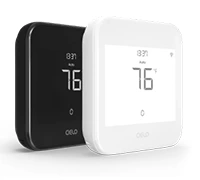
Budget-friendly smart thermostat for central HVAC systems. A thermostat that guarantees savings.
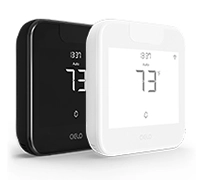
Award-winning smart thermostat for mini-splits. Technology that goes above & beyond.
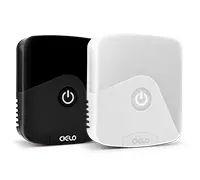
Sleekest smart thermostat for mini-split, window & portable ACs. A design that magically blends.
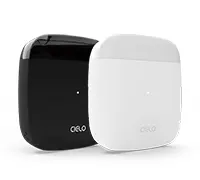
Smart mini-split thermostat that is engineered for affordable comfort. Small in size, big in benefits.
Inverter Heat Pump vs. Single-Stage vs. Two-Stage Units
- A single-stage heat pump works like a simple switch: either it’s running at full capacity, or it’s not running at all. This can lead to frequent cycling and noticeable temperature swings.
- A two-stage heat pump operates at two capacities. It typically runs at roughly 60-70% for everyday conditions and shifts to 100% only when the weather demands more heating or cooling.
- An inverter heat pump goes beyond fixed-stage operation by using a fully variable-speed compressor that continuously adjusts its output to match the exact heating or cooling demand. This results in the highest efficiency, quieter operation, and the most stable, precise temperatures of all three systems.
Load Sizing for Inverter Heat Pump Systems
A heat pump must be sized correctly to work efficiently. As a basic guideline, many contractors estimate 1 ton of heating or cooling for every 400–600 sq. ft., so a 1,200 sq. ft. home typically uses a 2-ton (24,000 BTU) unit. Since 1 ton = 12,000 BTUs, these estimates help gauge system size, but the most accurate sizing comes from a Manual J calculation.