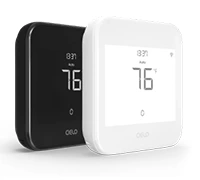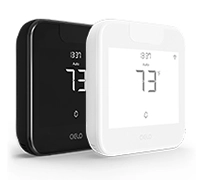
A non-programmable thermostat, or a manual thermostat, is a basic temperature control device that requires users to adjust the temperature manually. Once a temperature is selected using a dial or buttons, the thermostat holds that setting until it is changed again. Unlike programmable thermostats, it does not support schedules, automation, remote access, or learning features.
How Does a Non-Programmable Thermostat Work?
A non-programmable thermostat is simple: you set your desired temperature, and it signals your HVAC system to heat or cool until that temperature is reached. It either uses the bimetallic strip or a digital sensor to monitor the indoor temperature. Based on this reading, the thermostat compares the current room temperature to the user-selected setpoint. You can manually adjust the setpoint at any time using the thermostat’s temperature up/down buttons or rotary dial, depending on the model.
Types of Non-Programmable Thermostats
-
Mechanical Thermostats
Mechanical thermostats use a bimetallic strip consisting of two joined metal strips that expand and contract as the room temperature changes. When these strips move, they open or close the circuit that tells your heating or cooling system to turn on or off.
-
Digital Non-Programmable Thermostats
Digital non-programmable thermostats respond to electronic signals and are usually more accurate and responsive. They feature an easy-to-read digital display that typically shows heating and cooling modes, along with fan settings.
Pros & Cons of Non-Programmable Thermostat
|
Pros |
Cons |
|
Simple and easy to use |
No scheduling or automation |
|
Low cost and reliable |
Requires manual adjustments |
|
Easy to install and widely compatible |
Less energy efficient |
Are Non-Programmable Thermostats Energy-Efficient?
Non-programmable thermostats maintain a single set temperature until you manually adjust it. They cannot perform automatic temperature setbacks—like raising or lowering the temperature when you’re away—so they miss many simple opportunities to save energy.
According to ENERGY STAR, small routine adjustments can reduce heating and cooling costs. However, because non-programmable models rely entirely on manual input, their potential for energy savings is limited. In contrast, smart thermostats can make these adjustments automatically, resulting in greater efficiency and cost savings.