
A mini-split provides zoned heating and cooling for specific rooms without requiring ductwork. It’s easy to install and is ideal for areas that need targeted heating or cooling.
How Does a Mini-Split Work?
Mini-split works by transferring heat between the indoor and outdoor units. In cooling mode, the refrigerant absorbs heat from the indoor air, changes state from liquid to gas, and then moves to the outdoor unit. The compressor raises its pressure and temperature, and as the refrigerant flows through the outdoor coil, the fan blows air across it to release the heat to the outside. The refrigerant then cools, condenses back into a liquid, and returns indoors to repeat the cycle. The cool air is circulated throughout the space to maintain a comfortable environment.
In heating mode, the process reverses through a reversing valve that redirects the refrigerant flow. The refrigerant absorbs heat from the outdoor air, the compressor increases its temperature, and the hot refrigerant travels to the indoor coil. The resultant warm air is then circulated indoors.
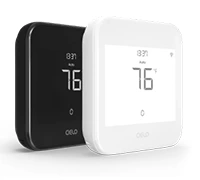
Budget-friendly smart thermostat for central HVAC systems. A thermostat that guarantees savings.
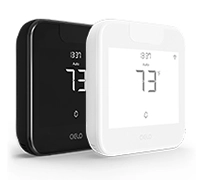
Award-winning smart thermostat for mini-splits. Technology that goes above & beyond.
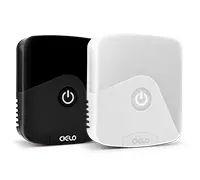
Sleekest smart thermostat for mini-split, window & portable ACs. A design that magically blends.

Smart mini-split thermostat that is engineered for affordable comfort. Small in size, big in benefits.
Single Zone vs. Multi-Zone Mini-Split System
A single-zone mini-split has one indoor unit connected to one outdoor unit, so it only heats or cools one room. A multi-zone mini-split connects several indoor units (up to 10) to one outdoor unit, allowing you to heat or cool multiple rooms independently.
Mini-split systems offer different indoor unit configurations to suit various room layouts. Common options include wall-mounted units, which install high on the wall, ceiling cassette units, which recess into the ceiling and deliver multi-directional airflow, and floor-standing units, which install low on a wall or near the floor when upper-wall or ceiling space is limited.
How to Calculate the Right Mini-Split Sizing?
Start by calculating the room’s square footage. Measure the length and width of the room, then multiply them together. For example, if a room is 12 feet long and 12 feet wide;
12 ft × 12 ft = 144 sq ft
Once you know the room or zone size, estimate the BTU requirement by multiplying the square footage by 25.
144 sq ft × 25 = 3,600 BTUs
Keep in mind that this method provides only a basic estimate. Proper mini-split sizing also depends on factors such as insulation, ceiling height, window area, and local climate.
Mini-Split vs. Central AC
Both mini-splits and central AC systems cool your home by absorbing indoor heat and releasing it outdoors. The key difference is how they distribute air. Central AC uses ducts to evenly cool the entire home, making it a great option when ductwork is already in place. Mini-splits deliver conditioned air directly into each room, making them ideal for home additions, older houses, and areas that need independent temperature control.