
The Energy Efficiency Ratio (EER) is a key metric used by the US Department of Energy (DOE) to measure the energy efficiency of air conditioning or heat pump systems under specific temperature conditions. Units with better energy efficiency consume less electricity, helping reduce both energy bills and environmental impact.
- EER = Cooling Output (BTU per hour)/Power Input (Watts)
For example, if an air conditioner produces 12,000 BTU/h of cooling while using 1,200 watts, its EER is 10.
EER vs EER2
Beginning January 1, 2023, the Department of Energy introduced EER2, the updated version of EER, as part of the new Appendix testing procedure. This updated standard modifies how systems are tested to better reflect real-world conditions. EER2 testing is conducted under fixed laboratory conditions, typically with the systems operating at outdoor temperatures of 95°F and indoor temperatures of 80°F, and at 50% relative humidity. While both EER and EER2 measure the same concept (cooling output divided by power input), EER2 testing is done under more realistic test parameters.
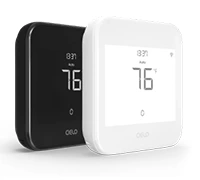
Budget-friendly smart thermostat for central HVAC systems. A thermostat that guarantees savings.
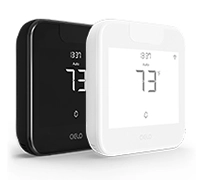
Award-winning smart thermostat for mini-splits. Technology that goes above & beyond.
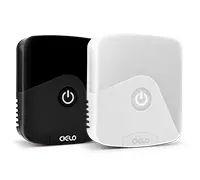
Sleekest smart thermostat for mini-split, window & portable ACs. A design that magically blends.
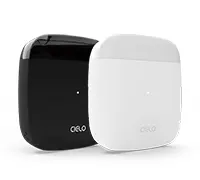
Smart mini-split thermostat that is engineered for affordable comfort. Small in size, big in benefits.
Regional EER2 Standards
The Department of Energy defines regional EER2 standards to ensure that air conditioners operate efficiently under varying climate conditions across the country. These standards differ slightly between the North, Southeast, and Southwest regions.
North Region
The North region has milder cooling demands. Systems installed in this region are expected to maintain energy-efficient operation while providing reliable cooling performance during shorter cooling seasons.
Southeast Region
The Southeast region experiences longer cooling seasons and higher humidity levels. Systems in this region are designed to maintain consistent efficiency over extended operating periods, ensuring comfort and reducing energy use.
Southwest Region
The Southwest region has distinct EER2 requirements due to higher cooling loads and hotter operating conditions.
- For systems with a cooling capacity below 45,000 BTU/hr, the minimum EER2 is 11.7 for standard-efficiency models and 9.8 for higher-efficiency models.
- For systems with a capacity of 45,000 BTU/hr or greater, the minimum EER2 is 11.2 for standard-efficiency models and 9.8 for higher-efficiency ones.
Single-package systems must achieve a minimum EER2 of 10.6 across all regions. - These regional EER2 standards ensure that air conditioning systems deliver efficient, consistent performance while minimizing power consumption under varying climate conditions.
ENERGY STAR® EER2 Requirements
To qualify for the ENERGY STAR® label, HVAC systems must meet specific energy-efficiency thresholds that exceed federal minimum standards. These requirements ensure that only the most efficient systems earn certification. In addition, outdoor units must be paired with compatible indoor coils to maintain the required performance levels.
For heat pump systems, split units must achieve at least 11.0 EER2, while single-package units, including gas/electric packages, must achieve at least 10.0 EER2. For air conditioning systems, split units must meet a minimum EER2 of 12.0, and single-package models must achieve 11.5 EER2.