
Global Warming Potential (GWP) measures how much heat a greenhouse gas traps in the Earth’s atmosphere over a set period. Greenhouse gases warm the planet by absorbing heat and slowing the rate at which they escape from the Earth’s surface. They act as an insulating layer, trapping energy and raising global temperatures.
How Is Global Warming Potential Calculated?
Global Warming Potential (GWP) is calculated by comparing the amount of energy a gas emits over a given period with that of 1 ton of carbon dioxide (CO2). The most commonly used time period for GWP calculations is 100 years. The United States Environmental Protection Agency (EPA) uses the same 100-year GWP values from the IPCC’s Fourth Assessment Report (AR4) in its regulations.
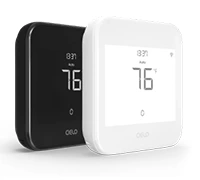
Budget-friendly smart thermostat for central HVAC systems. A thermostat that guarantees savings.
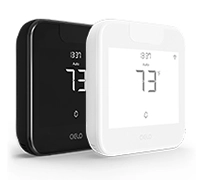
Award-winning smart thermostat for mini-splits. Technology that goes above & beyond.
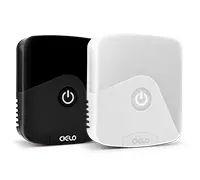
Sleekest smart thermostat for mini-split, window & portable ACs. A design that magically blends.
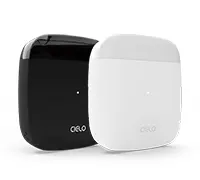
Smart mini-split thermostat that is engineered for affordable comfort. Small in size, big in benefits.
The larger the GWP, the greater the warming effect that gas has compared to CO₂ over the same timeframe.
Scientists determine GWP by considering two main factors:
- Radiative efficiency: how strongly a gas absorbs infrared radiation (heat).
- Atmospheric lifetime: how long the gas remains in the atmosphere before breaking down.
Understanding GWP & Its Relation to HVAC Refrigerants
Global Warming Potential (GWP) is a key factor in evaluating how refrigerants used in HVAC systems impact the environment. Since HVAC refrigerants are greenhouse gases, their GWP indicates how much heat they can trap in the atmosphere compared to carbon dioxide (CO₂). In HVAC systems, the choice of refrigerant directly affects a building’s carbon footprint and compliance with environmental regulations.
Refrigerants with a high GWP can contribute significantly to global warming if they leak into the air. Older refrigerants such as R-22 (Freon) have been phased out due to their ozone-depleting potential. It was replaced by R-410A, a blend of HFCs R-32 and R-125. It has no ozone impact but a high GWP of 2088. To reduce climate impact, the American Innovation and Manufacturing (AIM) Act sets a 700-GWP limit for HVAC systems starting in 2025, encouraging the adoption of low-GWP refrigerants.
Newer refrigerants with significantly lower Global Warming Potentials (GWPs) are emerging as sustainable alternatives to traditional refrigerants. R-32 has a GWP of 675, which is about 68% lower than R-410A, while R-454B has an even lower GWP of 466, approximately 78% lower than R-410A.
Shifting to low-GWP refrigerants is driven by years of research and innovation in HVAC technology. Manufacturers are shifting to green HVAC technologies to reduce greenhouse gas emissions. By adopting these sustainable alternatives, HVAC systems not only reduce their emissions but also support overall energy efficiency, making a meaningful contribution to mitigating climate change.